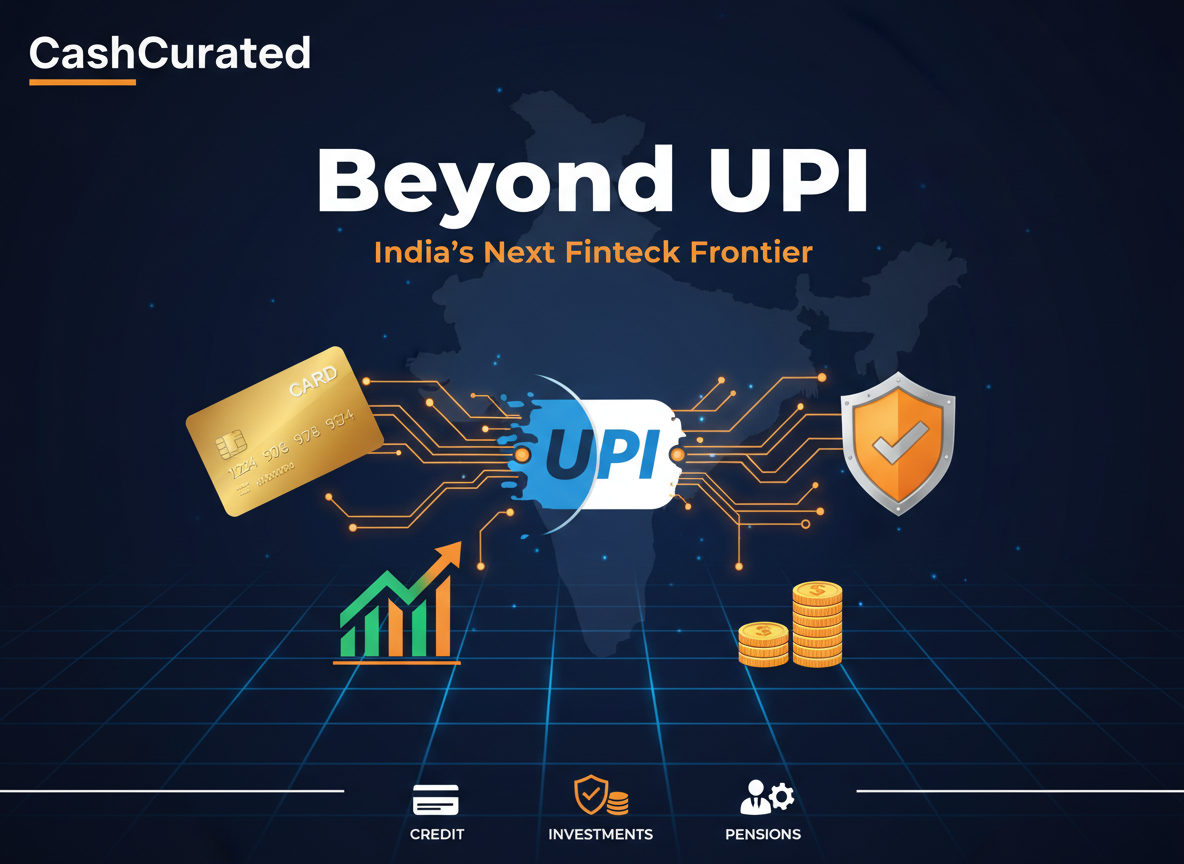
For much of the past decade, India’s fintech story has been defined by one system: UPI.
It transformed digital payments by making instant bank-to-bank transactions part of everyday commerce. India’s fintech opportunity is increasingly moving beyond payments into credit, insurance, investments, savings and pensions Payments remain the foundation, while credit, insurance, savings, investments, pensions and financial infrastructure are becoming the next areas of expansion.
That shift was clearly visible at the Global Fintech Fest 2026, where India’s fintech agenda has moved beyond payments towards financial inclusion, agentic AI, tokenisation, cybersecurity and data protection. Prime Minister Narendra Modi specifically called for fintech to expand into credit, insurance, savings, investments and pensions.
UPI Built the Foundation
UPI remains the strongest example of India’s digital finance infrastructure.
The platform processed a record 24.51 billion transactions worth ₹29.82 trillion in August 2026,
The bigger question now is what India can build on top of that payment infrastructure.
The question is whether the infrastructure built around digital payments can also make credit more accessible, insurance easier to distribute, investment products more efficient and financial services more personalised.
The opportunity is to use India’s digital rails for financial products where access, underwriting and distribution remain more difficult than payments.
Credit Could Be the Next Major Frontier
Credit is one area where India’s digital public infrastructure is moving from payments into financial intermediation.
At GFF 2026, RBI Governor Sanjay Malhotra highlighted the role of the Unified Lending Interface (ULI) and Account Aggregators in enabling data-driven, collateral-light credit, particularly for MSMEs.
“For an MSME lender, the value of ULI is less about another digital interface and more about reducing the information gap that has traditionally made small-business lending difficult.
The significance goes beyond technology.
Better access to verified financial data can potentially reduce information gaps between borrowers and lenders. For smaller businesses, that could improve access to formal credit. For lenders, better data can support more efficient underwriting and reduce some of the friction involved in traditional lending.
The opportunity, however, comes with a responsibility to protect privacy, maintain transparency and ensure that easier access to credit does not become indiscriminate lending.
From Payment Apps to Financial Infrastructure
The evolution of Indian fintech is also changing the nature of competition.
The first generation of fintech companies largely focused on consumer-facing applications. The next generation could increasingly provide the infrastructure behind financial services.
Account Aggregators, digital identity, UPI and other elements of India’s Digital Public Infrastructure create common rails on which banks, fintech companies and other financial institutions can build.
This opens opportunities across lending, insurance, wealth management, compliance, fraud prevention and financial operations.
The most valuable fintech companies of the next cycle may therefore not necessarily be the ones with the largest consumer apps. Some could be the businesses providing the infrastructure that other financial institutions depend on.
READ MORE ON INVESTMENT SCAMS FRAUD
Insurance and Wealth Remain Underpenetrated Opportunities
Payments are frequent and relatively simple. Insurance and investment decisions are more complex, which makes technology’s role different.
Digital distribution can reduce the friction involved in buying and servicing insurance. Better data can improve product matching and underwriting. Automation can simplify claims and back-office processes.
In wealth management, technology can make investment products easier to access and potentially improve personalisation.
But these sectors require a higher degree of trust.
A faster payment is primarily a convenience.
A credit decision, insurance policy or investment product can influence a household’s financial position for years.
That makes consumer protection, transparency and responsible use of data central to the next phase of fintech.
The Next Fintech Cycle Will Be About More Than Scale
India has already demonstrated that digital financial infrastructure can achieve enormous scale.
The next test is whether that scale can translate into deeper financial participation.
That means measuring fintech not only by transaction volumes, but also by outcomes: greater access to formal credit, wider insurance coverage, more efficient investment products, stronger fraud protection and better financial resilience.
This broader approach is consistent with the priorities emerging from GFF 2026, where cybersecurity, ethical data protection and consumer protection have been placed alongside technological innovation.
“Scale without adequate controls can create a different kind of financial risk.”
Technology can reduce financial friction, but weak controls can introduce new risks. Data can improve decisions, but poor governance can undermine trust. Automation can reduce costs, but financial institutions remain accountable for the systems they deploy.
India’s Fintech Opportunity Is Bigger Than UPI
UPI may remain the most visible symbol of India’s fintech success, but it is no longer the entire story.
The opportunity now extends across the financial value chain, from payments and credit to insurance, investments, pensions and financial infrastructure.
India has already shown that Digital Public Infrastructure can change financial behaviour at population scale.
The next challenge is to turn that infrastructure into a broader financial ecosystem that delivers measurable economic value.
UPI made digital payments mainstream. The next phase of Indian fintech will determine what comes after payments.
CashCurated viewpoint
UPI solved India’s payment problem at extraordinary scale. The next opportunity is harder: building financial products that improve access to credit, insurance and investments without compromising consumer protection.
The winners of the next fintech cycle may therefore be defined less by transaction volumes and more by the quality of financial infrastructure they build.
Disclaimer
This article is intended for general educational and informational purposes only. It does not constitute financial, investment, legal or professional advice. Financial products, regulations and fintech technologies are subject to change and may vary by provider and jurisdiction.
Leave a Reply