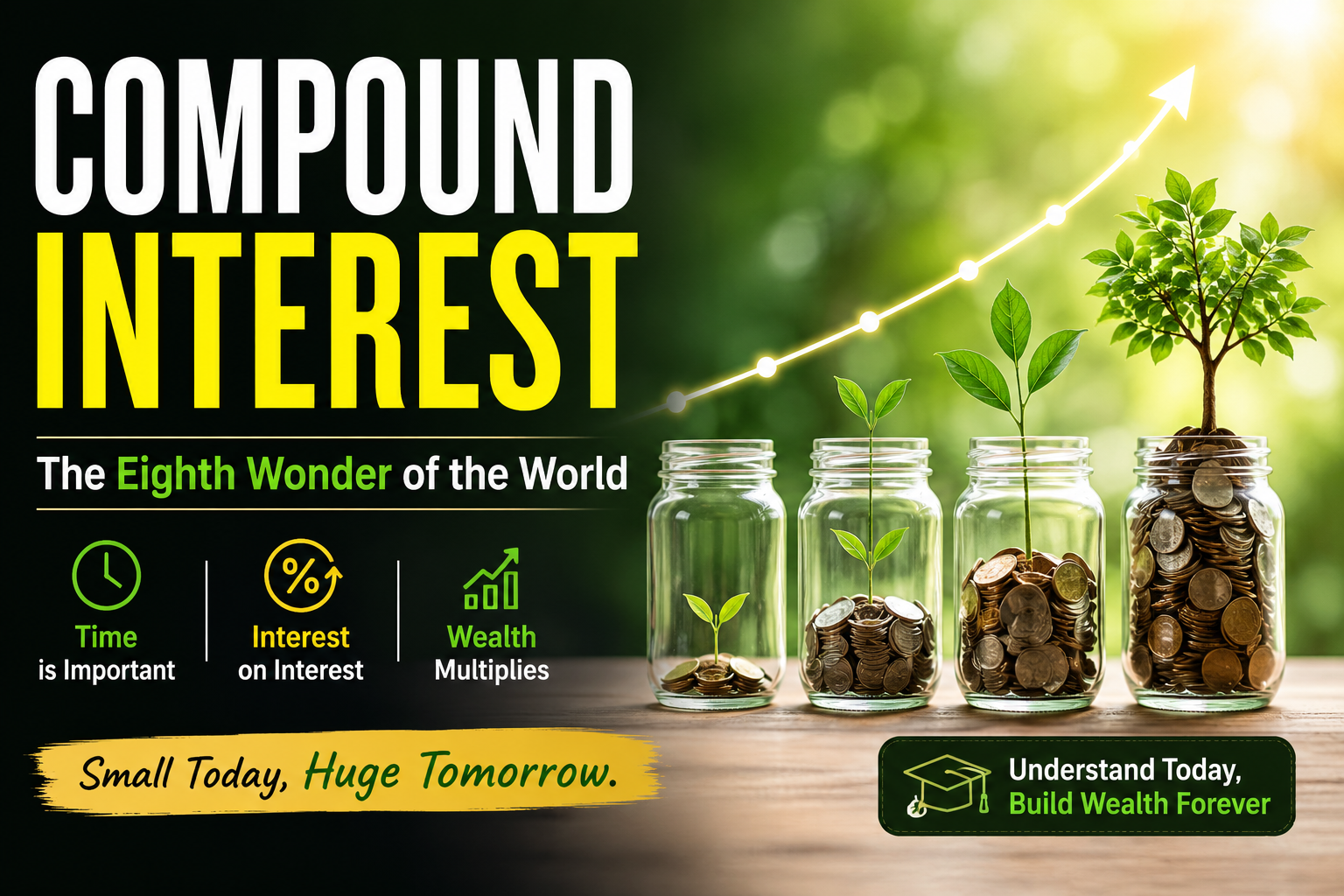
Compound interest is the interest you earn on both your original money (the principal) and the interest you’ve already accumulated.
What Is Compound Interest?
Have you ever wondered why starting to save early can make such a big difference?
It isn’t necessarily because the person who starts early has more money.
Sometimes, they simply have something more valuable: time.
That is where compound interest comes in.
Compound interest is interest earned on your original money as well as on the interest that has already accumulated. Investor.gov defines it as interest paid on both the principal and accumulated interest.
At first, the difference may look small.
Over many years, however, those small amounts can build on one another.
That’s the basic idea behind compounding.
How Does Compound Interest Work?
Let’s keep the mathematics simple.
Suppose you deposit $1,000 into an account that earns a hypothetical 5% annual interest, compounded once a year.
After the first year:
$1,000 + $50 = $1,050
Now the next year’s interest is calculated on $1,050 rather than just the original $1,000.
After the second year:
$1,050 + $52.50 = $1,102.50
That additional $2.50 is important.
You earned interest on the original $1,000, but you also earned interest on the $50 accumulated during the first year.
That is compounding.
The Consumer Financial Protection Bureau uses the same type of $1,000 and 5% example to explain how compound interest builds over time.
Compounding have the potential to beat the controlled inflation. In your SIPs you gain the effect of compounding.
Why Does Time Matter So Much?
The interesting part of compound interest isn’t necessarily what happens in the first year.
It is what happens after many years.
Using the same hypothetical 5% annual rate, $1,000 would grow approximately to:
| Time | Value |
|---|---|
| 1 year | $1,050.00 |
| 5 years | $1,276.28 |
| 10 years | $1,628.89 |
| 20 years | $2,653.30 |
| 30 years | $4,321.94 |
This example assumes:
- a starting amount of $1,000
- a constant 5% annual interest rate
- annual compounding
- no additional contributions
- no withdrawals
- no taxes or fees
It is a mathematical illustration, not a prediction of investment returns.
Investor.gov uses similar hypothetical examples to demonstrate how compound interest can increase the value of money over time.
Notice something interesting.
The growth isn’t linear.
The amount of interest earned in later years becomes larger because the balance itself has grown.
CHECK OUR SIP vs LUMPSUM ARTICLE
Compound Interest vs. Simple Interest
The easiest way to understand the difference is to look at what happens to the interest.
With simple interest, interest is generally calculated only on the original principal.
With compound interest, previously accumulated interest can also become part of the amount earning interest.
For example, with $1,000 at a hypothetical 5% annual rate:
Simple interest after 2 years:
$1,000 + $50 + $50 = $1,100
Compound interest after 2 years:
$1,000 × 1.05² = $1,102.50
The difference after two years is small.
Give the process more time, and the difference can become much more noticeable.
What Happens When You Keep Adding Money?
This is where compounding can become even more useful for someone who is building wealth gradually.
Imagine you don’t simply invest $1,000 and leave it there.
Instead, you continue adding money regularly.
Now there are two things working together:
Your contributions increase the amount of money you have invested.
Compounding can allow previously earned returns to contribute to future growth.
Investor.gov’s compound-interest calculator includes both an initial investment and regular monthly contributions, showing how contributions and time can affect potential future values.
This is why you don’t necessarily need to wait until you have a huge amount of money before beginning to save.
Consistency can matter.
Of course, the actual outcome depends on the financial product, interest or return, fees, taxes, contributions and how long the money remains invested.
Does Compound Interest Work the Same Way With Investments?
Not exactly.
This is an important distinction.
Compound interest is most directly associated with interest-bearing products.
Investments such as stocks, mutual funds and ETFs do not normally promise a fixed annual return. Their values can rise and fall, and investment returns are uncertain.
You may still hear people talk about compound growth when discussing investments.
The idea is similar: money stays invested, and returns that remain invested can contribute to future growth.
For example, dividends or interest received from an investment may be reinvested, allowing future returns to be generated on a larger amount.
But there is no guarantee that the investment will produce the same return every year.
That’s why a calculation showing a constant 5%, 7% or 10% return should be treated as an illustration, not a promise.
CHECK OUR SAVING vs INVESTING ARTICLE
Why Starting Early Can Make a Difference
Consider two people.
One starts saving a small amount at age 25.
Another waits until age 35 and then tries to save more each month.
The second person can still build significant savings.
But the first person has something the second person cannot recover:
those extra ten years.
Starting early gives money more time to potentially earn returns and for those returns to contribute to future growth.
The Consumer Financial Protection Bureau also highlights the importance of starting early when explaining how compound interest can increase savings over time.
This doesn’t mean you should panic if you started late.
It simply means that waiting indefinitely for the “perfect” time can have a cost.
What About Compounding Frequency?
Compound interest doesn’t always happen once a year.
Depending on the financial product, interest may be compounded annually, semi-annually, quarterly, monthly, daily or at another frequency.
Generally, when the stated rate and other terms are held constant, more frequent compounding can result in a higher effective amount of interest over a given period.
But don’t compare products based only on the word “compounded.”
You also need to understand the actual interest rate, fees, taxes, withdrawal rules and other terms.
The details matter.
Inflation Can Change the Picture
There is another part of the story that is easy to overlook.
Inflation.
Suppose your money grows by 5% over a period while the prices of the goods and services you buy also increase.
Your account balance may be higher, but that doesn’t automatically mean your purchasing power has increased by the same amount.
Investor.gov explains that inflation reduces purchasing power and can be an important risk for people holding money in fixed-interest products.
So when thinking about long-term financial goals, don’t look only at how much money you may have in the future.
Also ask:
What will that money actually buy?
Does Compound Interest Guarantee Wealth?
No.
This is perhaps the most important point to remember.
Compound interest is a mathematical concept.
It doesn’t guarantee that every financial decision will make money.
A savings account with a stated interest rate may provide interest according to its terms. An investment, on the other hand, can lose value.
Investor.gov notes that investments involve risk and that market values can fluctuate.
So be careful whenever someone uses a compound-interest calculator to promise a specific future amount.
A calculator can show what could happen under a particular set of assumptions.
It cannot tell you exactly what your investment will be worth in the future.
Common Mistakes People Make With Compound Interest
1. Waiting for a large amount of money
You don’t necessarily need a huge starting balance to develop a saving habit.
Starting with an amount you can realistically maintain may be more useful than waiting for the perfect opportunity.
2. Assuming returns will be the same every year
A calculation may assume a constant rate.
Real investments can behave very differently.
Some years may produce positive returns. Others may produce negative returns.
3. Ignoring fees and taxes
The amount you actually keep can be affected by fees, taxes and other costs.
These may seem small individually, but over a long period they can affect your results.
4. Confusing higher returns with guaranteed returns
A higher assumed return can make a calculator show a much larger future balance.
That doesn’t make the assumption realistic or guaranteed.
5. Focusing only on the final number
A future balance can look impressive on paper.
But the assumptions behind that number matter just as much.
Always ask:
What rate was assumed?
For how long?
How often is it compounded?
Are contributions included?
What about fees, taxes and inflation?
Compound Interest Isn’t a Get-Rich-Quick Trick
There is nothing magical about compounding.
It doesn’t turn a small amount of money into a fortune overnight.
Its real strength is much less exciting, but much more useful:
time + consistency + reinvestment.
You may not notice much happening in the beginning.
That’s normal.
The process becomes more meaningful as the balance grows and previously earned returns remain in the account or investment.
In other words, compounding rewards patience more than excitement.
How Can You Make Compounding Work for You?
There is no single financial product that is right for everyone.
Start with your goal.
If you’re saving for something you may need soon, preserving access to your money and avoiding unnecessary investment risk may be more important.
For longer-term goals, investing can provide opportunities for growth, but it also comes with risk.
Investor.gov recommends considering factors such as your goals, time horizon and risk tolerance when deciding how to save and invest.
A simple approach is to ask yourself:
What am I saving for?
When will I need the money?
How much can I realistically save or invest?
What level of risk am I comfortable taking?
Once you understand those answers, you can choose financial products more thoughtfully.
Final Thoughts
Compound interest is one of those financial concepts that sounds complicated until you see the numbers.
You start with some money.
It earns interest.
That interest becomes part of the balance.
The larger balance can then earn more interest.
And the process continues.
The biggest lesson isn’t that you need to find an investment promising extraordinary returns.
It’s that time can be incredibly valuable when money is allowed to grow and previously earned returns remain invested.
So instead of asking:
“How can I get rich quickly?”
A better question might be:
“What can I consistently save or invest today, and how long can I leave it working?”
You don’t need to predict the future to understand compound interest.
You just need to understand the value of time, consistency and patience.
⚠️ The Double-Edged Sword: Wealth Degraders
While compounding is your best friend when investing, it is your worst enemy when borrowing.
- Credit Cards & Loans: Credit cards compound your debt monthly or even daily. If you only pay the minimum balance, the interest charges compound rapidly, trapping you in a cycle of debt.
- The Cost of Waiting: The absolute biggest factor in compounding is time. Delaying your savings journey by even 5 years can cut your ultimate retirement nest egg in half.
Disclaimer
This article is for general educational purposes only and does not constitute investment, financial, tax or legal advice.
Interest rates, investment returns, taxes, fees, regulations and financial products vary by country and provider. Investment returns are not guaranteed, and investments can lose value. Consider your own financial circumstances and review the official information for any financial product before making a financial decision.

Leave a Reply